Baseball Performance Testing in Santa Clarita
Objective testing for baseball athletes who want to improve speed, power, strength, agility, and on-field performance — and to see those gains measured, not assumed.
Why Baseball Athletes Need Testing
Baseball rewards a specific blend of explosiveness and durability — a quick first step, a fast bat, and an arm that holds up deep into a long season. Whether an athlete is chasing a varsity spot, a college roster, a pro look, or simply his own ceiling, what separates players at every level is rarely effort. It's how precisely that effort is aimed.
Objective testing replaces guesswork with a clear picture of where an athlete stands and what's actually holding him back — so every training decision has a reason behind it, and progress can be tracked over time instead of assumed.
Measure → Train → Retest
The Physical Qualities That Drive Baseball Performance
Baseball performance isn't one ability — it's a combination of qualities that show up in every sprint, throw, swing, and defensive read. Here's what matters, and why.
Speed & Acceleration
Baseball is often decided in the first few steps. Sprinting out of the batter's box, stealing a base, tracking a fly ball, or reacting on defense all depend on how quickly an athlete can get moving. Acceleration is one of the most important athletic qualities in the game.
Power
Power drives nearly every explosive movement in baseball — sprinting, throwing, jumping, and hitting. Athletes who produce force quickly tend to show greater explosiveness on the field.
Strength
Strength is the foundation beneath acceleration, power production, deceleration, and long-term athletic development. It's what lets the other qualities express themselves and helps an athlete hold up over a long season.
Change of Direction
Baseball athletes constantly accelerate, stop, cut, and re-accelerate. Efficient change-of-direction ability shapes both offensive and defensive performance — from base running to defensive range.
Durability & Readiness
Availability matters. Monitoring asymmetries, force production, and recovery helps an athlete reduce avoidable risk and make more informed return-to-play decisions. (Testing informs these decisions — it doesn't replace medical guidance.)
Arm Care & Throwing Readiness
Baseball asks the shoulder and elbow to do something few other sports demand: produce and absorb enormous force, overhand, thousands of times across a season. That repeated throwing load is what makes arm care a baseball-specific priority — and it's one of the most common concerns we hear from parents.
Objective testing gives that concern something concrete to act on. By measuring shoulder strength, range of motion, and the difference between the throwing and non-throwing side, we can establish a baseline for a healthy arm and monitor how it holds up as throwing volume climbs. A meaningful drop in strength, or a growing imbalance between sides, is information worth catching early — so workload, recovery, and training can be adjusted before a small asymmetry becomes a bigger problem.
To be clear: testing doesn't diagnose or treat injuries, and it doesn't replace a physician, physical therapist, or athletic trainer. What it does is give athletes, parents, and coaches objective data to make smarter decisions about throwing workload and return-to-throwing progressions — alongside appropriate medical guidance.
Measure → Monitor → Adjust
The Growing Importance of Performance Data in Baseball
No sport has embraced measurement quite like baseball. Exit velocity, throwing velocity, sprint times, spin rate — numbers that once lived only in front offices now show up at travel-ball tournaments and high school showcases. The game has decided, at every level, that talent is easier to develop when you can actually see it.
The same logic applies to the physical engine underneath those numbers. Force plates, electronic sprint timing, and strength-testing technology let coaches measure the qualities that produce a faster swing, a quicker first step, and a more resilient arm — then build training around the specific areas an athlete needs most. The guesswork comes out. Strengths, hidden gaps, and real progress over time come into focus.
And this isn't reserved for first-round picks. The same objective approach that shapes decisions in professional player-development systems is now within reach for the 12-year-old learning to train with intention and the high schooler trying to prove his work is paying off.
At PowerSource, we bring these assessment technologies to athletes right here in Santa Clarita—delivering objective insight into speed, power, strength, change of direction, and athletic readiness. Our process is simple: Measure → Train → Retest. It gives athletes, parents, and coaches the clarity to make decisions based on data, not guesswork. Learn more about Objective Performance Testing
What Coaches Learn
Coaches gain objective information about:
- Acceleration ability
- Force production
- Power output
- Change-of-direction performance
- Athlete development over time
- Return-to-play readiness
- Team-wide performance trends
What Parents Learn
Parents frequently want to know:
- Is my athlete getting faster?
- Is training actually producing results?
- Is one side significantly weaker than the other?
- Which physical qualities should we prioritize?
- How does he compare to his previous testing results?
Baseball-Specific Performance Demands
The same athletic qualities show up in specific, recognizable moments on the field. This is where testing connects to the game.
First-Step Quickness — The play often hinges on reaction and acceleration in the opening step.
Home-to-First Speed — One of the most telling performance indicators for position players, and a number recruiters notice.
Base Running — Acceleration and top-end speed directly expand offensive opportunities.
Defensive Range — Speed and change-of-direction ability let an athlete cover more ground and reach more balls.
Lateral Movement — Critical for infielders, catchers, and countless defensive situations.
Return-to-Play Decision Making — Objective testing helps guide a sensible progression following injury, alongside appropriate medical and coaching input.
What We Measure
Each quality above maps to specific, repeatable tests. Standardized measurement is what makes progress trackable from one assessment to the next.
Speed & Acceleration
- 10-Yard Sprint
- 20-Yard Sprint
- Sprint Velocity
Lower Body Power
- Countermovement Jump
- Jump Height
- Reactive Performance Metrics
Strength & Force Production
- Isometric Strength Testing
- Relative Strength Metrics
- Left vs. Right Comparisons
Change of Direction
- Pro Agility (5-10-5)
- Movement Asymmetries
Arm Care & Throwing Readiness
- Shoulder Internal/External Rotation Strength
- Throwing vs. Non-Throwing Comparisons
- Range-of-Motion Screening
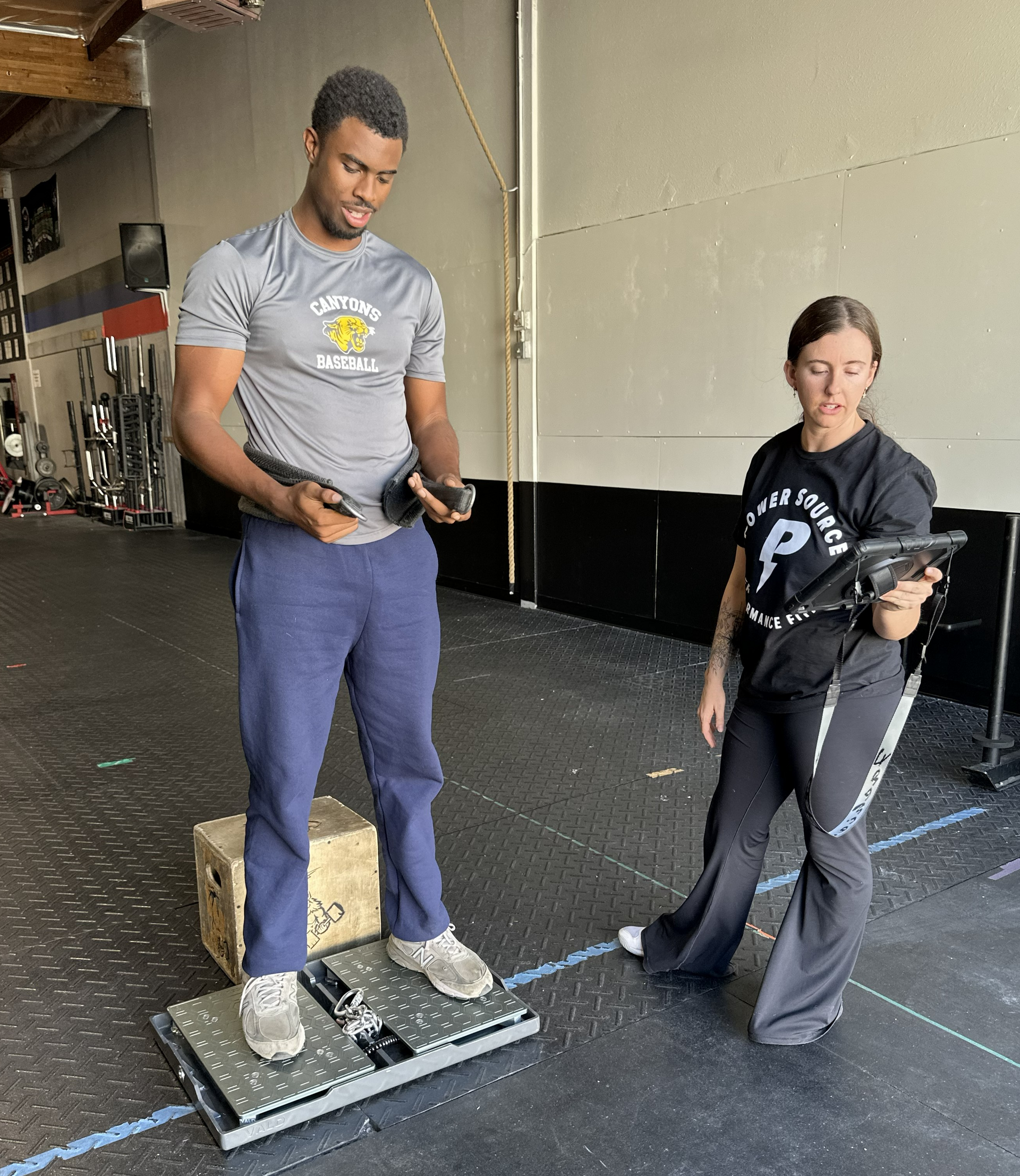
- Strength & Asymmetry via VALD ForceFrame
How Objective Testing Helps Baseball Recruiting
Let's be clear up front: testing numbers don't earn scholarships, and a fast sprint time won't put an athlete on a roster by itself. College coaches and professional scouts recruit players, not data points. But used the right way, objective testing becomes a powerful tool in an athlete's development and a meaningful part of how he presents himself to programs.
It Tells an Athlete Exactly What to Work On
The best athletes are relentless about improvement—but improvement is hard when you're guessing. Performance testing gives a clear starting point by pinpointing real strengths and specific gaps. Instead of training on instinct, athletes and coaches can build a plan around measurable needs, so every session has a purpose.
It Speaks the Language Coaches Already Use
Speed, explosive power, strength, and change-of-direction ability show up on the field, and college and professional programs evaluate them constantly. Objective testing lets an athlete see how he stacks up against recognized performance standards—and gives coaches and scouts reliable, apples-to-apples information instead of a highlight reel. When an athlete can back up what he does in a game with numbers, he becomes easier to evaluate and easier to trust.
Progress Over Time Tells the Real Story
A single test is a snapshot. The real value comes from a documented trajectory—months and years of data showing speed, power, and strength climbing as training takes hold. That history does two things a one-time score never can: it shows an athlete whether his training is actually working, and it shows coaches something they care about deeply—commitment, coachability, and a player on an upward curve. A rising trend line is often more compelling than a strong number in isolation.
At PowerSource, our approach is simple: Measure → Train → Retest. By pairing objective testing with targeted training, baseball athletes don't just collect data—they build a clear, honest record of development they can carry through their entire recruiting journey.
Technology That Powers Our Assessments
VALD SmartSpeed — Electronic sprint timing for accurate, repeatable speed data.
VALD ForceDecks — Power, force, and asymmetry analysis.
VALD ForceFrame — Strength testing and force-production measurement.
InBody — Body composition monitoring.
Supporting Local Baseball
PowerSource is proud to support the baseball community here in Santa Clarita. We work with travel, club, and high school athletes across the valley who are serious about developing their game.
Coaches, talk to us about how we can support your program.
Frequently Asked Questions
Why isn't my baseball player getting faster?
Speed plateaus for many reasons — training that isn't targeting the right quality, technique limitations, strength deficits, fatigue, or simply no objective feedback to guide adjustments. Testing isolates which underlying quality (acceleration, top speed, strength, or mechanics) is the bottleneck, so training can address it directly instead of guessing.
How fast should a baseball player run?
There's no single benchmark — it depends on age, position, and competition level. A strong home-to-first or 60-yard time for a 12U athlete looks very different from what college coaches and scouts expect at the varsity level and beyond. That's exactly why individualized baselines and retesting matter more than chasing a universal number: progress against his own data is the most meaningful measure of whether training is working.
Does testing help with recruiting?
Objective, verifiable performance data can strengthen a recruiting profile by giving college coaches and professional scouts measurable information alongside game film. It doesn't replace on-field performance, but standardized metrics — sprint times, jump height, strength scores — add credible, comparable context.
Should I worry about my child's throwing arm?
It's one of the most common concerns we hear, and a reasonable one given how much baseball asks of the shoulder and elbow. Objective testing won't diagnose or treat an arm issue, but it can establish a healthy baseline and flag meaningful changes in strength or side-to-side symmetry as throwing volume increases — useful information to share with your coach and, when appropriate, a medical professional.
How often should baseball athletes be tested?
Many athletes benefit from testing roughly every 8 weeks. That window aligns with typical training cycles — long enough to show real change, frequent enough to keep training on track. Season transitions are also a natural checkpoint.
What age should athletes begin testing?
Athletes can usually begin foundational testing in the late-elementary to middle-school years, with the early focus on movement quality and establishing a baseline rather than maximal output. Tests are scaled to the athlete's age and stage of development.
Is testing safe?
Yes. Assessments are non-invasive and built around movements athletes already perform — sprinting, jumping, and controlled strength tests — supervised by trained staff and scaled appropriately. A proper warm-up and sensible progression are part of every session.
How long does a baseball assessment take?
A full assessment typically runs about 45–60 minutes, including warm-up, the testing battery, and a review of results.
Related Resources
Keep exploring the science behind athletic development and the performance factors that drive success on the baseball field.
What Is Force Plate Testing?
See how force plate technology measures power, balance, and side-to-side asymmetries—revealing insights about athletic readiness that traditional fitness testing misses entirely.
[Read More]
Force Plate Testing · 3 min read