Speed & Acceleration Training and Testing
Know exactly what limits your speed and build a plan to improve it.
Why Speed Matters
Speed is one of the most valuable skills an athlete can develop—and one of the biggest differences between good players and great ones. Whether your athlete is chasing down a ball, stealing a base, beating a defender, or creating separation in the open field, being faster gives them a real edge in competition.
The good news for athletes ages 12–18: speed isn't just something you're born with. It can be trained, improved, and measured.
Does Speed Really Matter in Every Sport?
Yes. In football, baseball, softball, soccer, basketball, and lacrosse, athletes are constantly accelerating, sprinting, slowing down, and changing direction. The faster an athlete can get from point A to point B, the more chances they have to make the plays that win games. Speed creates opportunities that talent alone can't.
How Does Being Faster Help an Athlete Compete?
Speed does more than improve a sprint time—it changes what an athlete can do on the field or court.
Faster athletes can:
- Reach balls slower players can't get to
- Create separation from defenders
- Cover more ground on defense
- Put pressure on the other team
Even a small improvement in speed can make a noticeable difference in how an athlete performs in a game.
Can Speed Actually Be Trained?
Absolutely—but only when it's measured correctly. Many young athletes train for years without ever knowing if they're actually getting faster. Objective testing takes out the guesswork. By measuring acceleration, sprint speed, and force production, athletes and coaches can find out exactly what's holding them back, focus on the right training, and track real progress over time.
How PowerSource Helps Athletes Get Faster
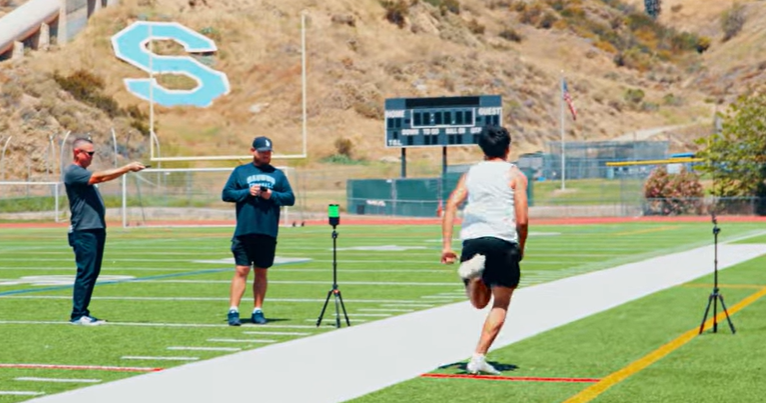
At PowerSource, we use professional timing systems and performance-testing technology to measure each athlete's speed and pinpoint exactly what's limiting it. That means athletes train with a clear purpose—and parents see real, measurable results instead of guesswork.
Speed vs. Acceleration vs. Change of Direction: What's the Difference?
Lots of athletes say they want to "get faster"—but speed is only one piece of how the body moves in sports. To actually improve, it helps to understand three separate skills: acceleration, top speed, and change of direction. Most athletes are stronger in one than the others, and knowing which is which is the first step to real improvement.
Acceleration: How Quickly Can You Get Moving?
Acceleration is how fast an athlete can build speed from a standing or near-standing start. In most sports, athletes rarely run far enough to hit their top speed—which makes acceleration one of the most important qualities to develop.
How we measure it:
- 10-yard sprint time
- 20-yard sprint time
- Force production testing
Why it matters:
- Stealing bases in baseball and softball
- Exploding off the line in football
- Beating defenders to loose balls
- Creating separation in field and court sports
For many athletes, the game is won in the first 10 yards.
Top Speed: How Fast Can You Go Once You're Running?
Top speed is an athlete's ability to keep building velocity after the initial burst. It's a real weapon—but only when there's enough space and time to reach it.
How we measure it:
- Sprint split times
- Velocity measurements
- Speed retention metrics
Why it matters:
- Breakaway runs in football
- Running down fly balls in baseball and softball
- Open-field situations in soccer and lacrosse
- Fast-break transitions in basketball
Acceleration gets an athlete moving. Top speed decides how fast they can keep going.
Change of Direction: How Well Can You Stop and Go Again?
Almost no sport is played in a straight line. Athletes have to slow down, stop, cut, and re-accelerate over and over. This skill depends on braking strength, balance, coordination, and force production—and it's often the most overlooked.
How we measure it:
- Pro Agility (5-10-5) testing
- Braking and re-acceleration metrics
- Relative strength assessments
Why it matters:
- Defensive play in baseball and softball
- Route running in football
- Locking down opponents in basketball
- Agility in soccer and lacrosse
The athlete who can stop and re-accelerate efficiently often gains the biggest edge of all.
Why We Test All Three
Here's the key: many athletes think they have a speed problem when the real issue is acceleration, braking ability, or force production. By testing each skill separately, we can find out what's actually limiting performance—and build training that targets each athlete's biggest opportunity to improve.
Measure → Train → Retest
What We Measure
At PowerSource, we use professional electronic timing systems to measure how athletes accelerate, build speed, and hold velocity. Instead of relying on hand-timed results or a coach's eye, we provide objective data—so athletes, parents, and coaches can see exactly where performance stands today and where the biggest opportunities to improve are hiding.
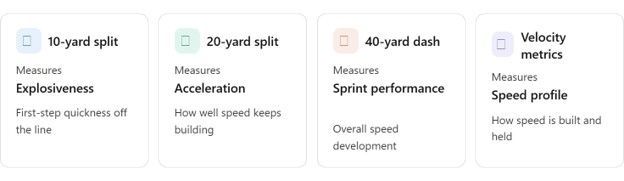
What Does the 10-Yard Split Measure? (First-Step Explosiveness)
The first 10 yards are often the most important part of any sprint. This measurement shows how quickly an athlete can produce force and accelerate from a dead stop.
The 10-yard split matters most for:
- Football players exploding off the line of scrimmage
- Baseball and softball players sprinting out of the batter's box
- Soccer players chasing down through balls
- Any athlete in short-distance, game-speed situations
A strong 10-yard split usually reflects an athlete's ability to produce force quickly and accelerate efficiently.
What Does the 20-Yard Split Measure? (Acceleration)
The 20-yard split shows how well an athlete keeps building speed after the initial start. Some athletes burst out fast but stall; others keep accelerating and gain ground as the sprint continues.
This metric helps identify:
- Acceleration strengths and weaknesses
- Where there's room for sprint development
- How well an athlete's strength and power are turning into actual movement speed
For many field and court sports, acceleration through 20 yards matters more than top speed.
What Does the 40-Yard Dash Measure? (Speed Development)
The 40-yard dash gives a bigger-picture look at how an athlete accelerates and then maintains speed over a longer distance.
It's best known for football, but it offers useful insight into overall sprint performance and athletic development for any sport.
The 40-yard dash helps coaches evaluate:
- Overall sprint ability
- Speed development over time
- Acceleration versus top-speed performance
What Are Velocity Metrics? (Your Speed Profile)
Sprint times tell part of the story. Velocity metrics explain how those times happened.
By analyzing speed across different portions of a sprint, we can see:
- How effectively an athlete builds speed
- Whether they keep accelerating or plateau early
- How well they hold velocity as the distance increases
This helps us spot athletes who need more force production, cleaner sprint mechanics, or more specific speed-development training.
Why Measuring Multiple Segments Matters
Two athletes can run the exact same 40-yard dash time for completely different reasons. One might have explosive acceleration but fade late in the sprint. Another might start slow but keep building speed the whole way.
By measuring multiple sprint segments and velocity, we get a complete picture of each athlete's performance—and can make smarter, more personalized training recommendations.
Measure →Train → Retest
What's Really Limiting Your Speed?
Most athletes assume the fix is simple: just run more sprints. But speed is usually held back by one or more underlying physical qualities—and until you know which one, more sprinting won't fix it. Here are the five most common speed limiters we test for.
Not Enough Force Production
Speed starts with force. Athletes who can't drive enough force into the ground struggle to accelerate—no matter how hard they train. Build force, and you build faster, more powerful first steps.
Low Power Output
Power is force produced fast. An athlete can be strong in the weight room and still lack the explosiveness that shows up in a game. Testing reveals whether that weight-room strength is actually translating to the field.
Inefficient Sprint Mechanics
Even strong, powerful athletes leave speed on the table with poor mechanics—bad body position, sloppy arm action, or off-timed strides. Cleaning up movement is often the fastest path to a faster time.
Insufficient Strength
Strength is the foundation under everything—acceleration, top speed, and change of direction. Athletes with low relative strength simply can't produce the force needed to explode, stop, and go again.
Poor Braking Ability
Fast isn't only about going—it's about stopping. Athletes who can't decelerate and absorb force struggle with agility, change of direction, and staying healthy.
Every Athlete Is Different
Two athletes can post the exact same sprint time for completely different reasons—and need completely different training to improve. That's the whole point of objective testing: it pinpoints your specific limiter so you train the thing that actually moves the needle.
Measure → Train → Retest
The Technology Behind the Results
ccurate data starts with accurate tools. At PowerSource, we use professional performance-testing technology trusted by pro organizations, college programs, and leading sports-performance facilities around the world.
No stopwatches. No guessing. Our systems deliver objective data—so athletes, parents, and coaches can make training decisions based on real numbers instead of opinions.
VALD SmartSpeed: Precision Sprint & Agility Testing
SmartSpeed timing gates capture sprint and agility data with a level of accuracy a stopwatch can't match. By measuring sprint splits electronically, athletes get objective results for acceleration, top speed, and change of direction.
That precision lets us see exactly where an athlete excels—and where the real opportunities to improve are.
VALD ForceDecks: Measuring Power & Force
ForceDecks measure how an athlete produces and absorbs force during movements like jumping, landing, and explosive efforts—the hidden qualities behind speed.
Here's what they reveal:
- Explosiveness and power
- Force production
- Left-to-right movement asymmetries
- Braking and deceleration ability
- Performance readiness and athlete monitoring
These are insights you simply can't see with the naked eye, which means athletes can train with far greater precision.
Objective Data. Better Decisions.
When speed testing is paired with force and power assessments, the full picture comes into focus. The payoff: targeted training, measurable progress, and real confidence that the work is actually paying off.
Learn more about the technology behind our athlete assessments.
How We Help Athletes Get Faster
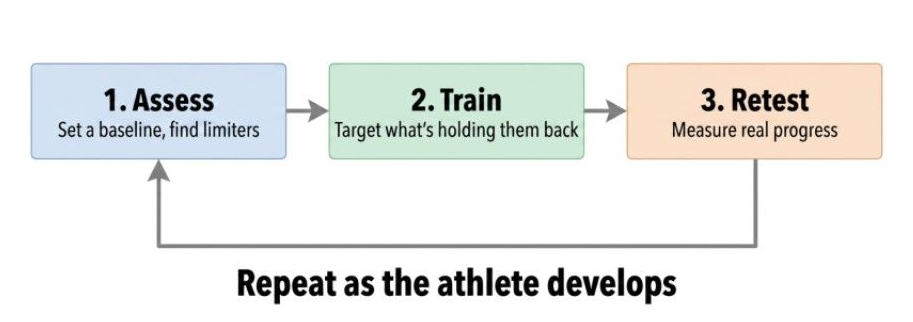
Getting faster isn't guesswork. It starts with understanding where an athlete is today, pinpointing what's holding them back, and measuring progress along the way. Here's the three-step process we use with every athlete.
Step 1: Assess
Every athlete starts with objective performance testing. Using professional timing systems and force-measurement technology, we evaluate acceleration, sprint performance, power, and force production to set a baseline and uncover the biggest opportunities to improve.
Questions we answer:
- How fast is the athlete?
- How quickly do they accelerate?
- Are they producing force efficiently?
- What's actually limiting their performance?
Step 2: Train
Once we have the data, training gets pointed exactly where it's needed. Some athletes need more strength. Others need better power, cleaner sprint mechanics, or sharper change of direction. The goal is simple: focus the work where it produces the biggest return.
Training may focus on:
- Strength development
- Power development
- Acceleration
- Sprint mechanics
- Braking and change of direction
Step 3: Retest
Progress should be measured, not assumed. Retesting lets athletes and coaches confirm the training is working, see real change, and spot the next area to develop. Instead of relying on opinions, athletes see measurable improvement in speed, acceleration, force production, and overall performance.
The result:
- Clear benchmarks
- Objective progress tracking
- Data-driven training decisions
- Real confidence in the process
Measure → Train → Retest
Assess where you are. Train what matters. Measure the results. That's how real, long-term athletic development happens.